





The document that transfers your Puerto Vallarta property is longer, denser, and more consequential than most foreign buyers expect. Many people skim the escritura pública, the public deed drawn up by the notario público, looking only for their name, the price, and a signature line. That habit is how errors survive into the Public Registry. A deed carries the legal history of the property, its boundaries, its tax figures, and the trust structure that will govern your ownership for decades. This guide walks through the sections in the order they appear, explains what each one should prove, and shows where the problems usually hide.
Table of Contents
- Quick Takeaways
- What the Escritura Pública Is and How It Differs From a Contract
- Who Holds Authority at the Signing Table
- Reading the Antecedentes and the Chain of Title
- The Property Description, Boundaries, and Cadastral Key
- Price, Taxes, and What the Deed Declares
- Deed, Promissory Agreement, and Registry Certificate Compared
- Reading the Fideicomiso Clause in the Deed
- Common Errors Foreign Buyers Make at the Table
- A Pre-Signing Checklist for Puerto Vallarta Buyers
- Frequently Asked Questions
- References
Quick Takeaways
| Key Insight | Explanation |
|---|---|
| The notary is an official, not your advocate | The notario verifies identities, calculates taxes, and files the transfer. Only your own lawyer works exclusively for your interests, so read the deed with that in mind. |
| The deed must match the Public Registry | Compare the owner name, the registry references, and the property description against a current registry certificate before you pay any deposit. |
| Boundaries are a legal description | The measurements and adjoining owners listed in the deed should match the survey and the cadastral record. A mismatch is a question that needs a written answer. |
| The antecedentes must form an unbroken chain | Each earlier transfer should hand the property to the next owner. Gaps, unrecorded transfers, or missing earlier deeds should be resolved before signing. |
| Tax lines should be itemized in writing | Ask for the acquisition tax, registration fees, and notary fees as separate figures, and confirm which value the tax calculation is based on. |
| Restricted-zone property should show a bank trust | Within 50 km of the coast, foreign buyers normally hold through a fideicomiso. A deed that presents a foreign individual as direct owner of coastal property is a red flag. |
What the Escritura Pública Is and How It Differs From a Contract
The escritura pública is the deed that transfers ownership in Mexico. It is drawn up by a notario público, a state-appointed attorney, and it carries public-instrument weight that a private agreement does not. Once the notary signs and the transfer is filed, the document becomes the official record of what you bought, from whom, and on what terms.
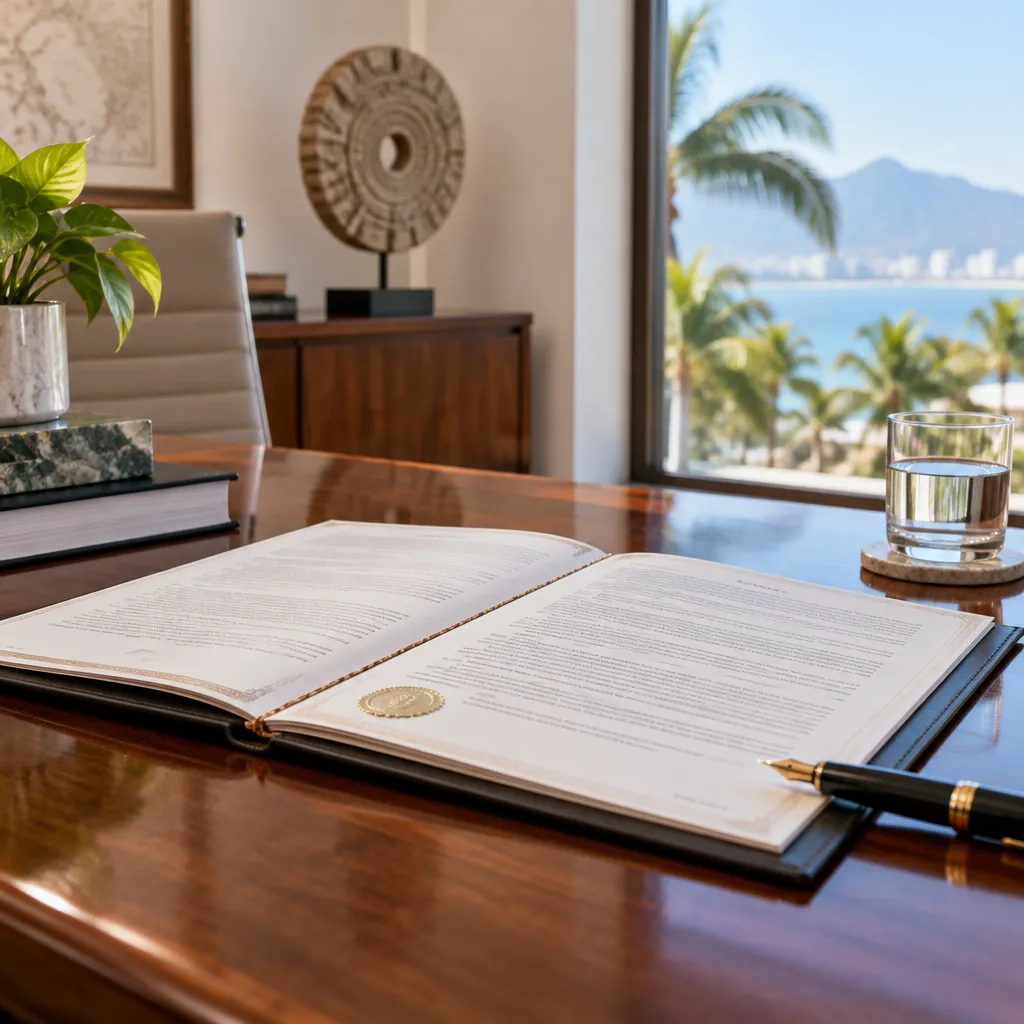
Most foreign buyers meet a different document first. The promissory agreement, negotiated between buyer and seller, sets the price, the deposit, and the target closing date. It is a private contract. It can bind the parties, but it does not transfer title and it does not put your name on the Public Registry. Treating it as proof of ownership is the same mistake that makes uninscribed parcels so risky.
Why the deed matters more than the promise
In practice, the deed is the document that survives a dispute. Registries and banks look at the escritura, not at the email chain that preceded it. If the deed says one thing about the property and the marketing brochure says another, the deed governs. A buyer who signs without reading the deed is trusting whoever drafted it.
The deed also records the details that drive future costs: the declared price, the tax calculations, the legal description, and the trust structure if the property sits in the restricted zone. Each field affects what you pay later, what you pay when you resell, and how your heirs will inherit. Reading the deed is less about legal trivia and more about checking the numbers that will follow you for years.
A deed is only as reliable as the registry record it was checked against. A clean-looking document can still describe the wrong property, the wrong owner, or the wrong price.
Who Holds Authority at the Signing Table
The Mexican notary is the person most foreign buyers misjudge. A US notary witnesses a signature. A Mexican notario formalizes the transaction, calculates the taxes the sale triggers, and files the transfer with the Public Registry. The notary works for the legal process, not for either party, and that is why the notary cannot be your advocate.
Your own lawyer is the only party working exclusively for your interests. That distinction matters at the signing table, when the notary’s reading of the deed carries official weight and your questions need answers before the pen moves. A bilingual lawyer can explain the legal meaning of each clause as it is read, which is more useful than a word-for-word translation of a document you cannot change on the day.
What the notary verifies before the signing
The notary checks identities, confirms that the seller has authority to sell, reviews the registry record, and determines the taxes and fees. Those checks are the notary’s job, but they are not a substitute for your review. The notary works from the documents submitted to them, so an incomplete file produces an incomplete check.
Ask for the current registry certificate before you pay any deposit, and match the seller’s name to the passport on the deed. If the names differ in spelling, marital surname, or company form, stop and get a written explanation. Do not wait for signing day to discover the mismatch.
Pro tip: Request a draft of the deed several days before the signing and mark every name, number, and boundary you cannot match to your registry certificate. Bring the marked copy to your lawyer, not to the notary’s office on the day.
Reading the Antecedentes and the Chain of Title
The antecedentes section, the historical background of the deed, records earlier transfers of the same property. It shows who owned the land before the seller, how the seller acquired it, and which earlier deeds were recorded. Read it as a chain, where each owner hands the property to the next through a recorded transaction.
A clean chain is not proof of perfect title on its own, but a broken one is a warning. Gaps, unrecorded transfers, or references to documents you cannot locate need an answer before you sign. Ask the seller’s lawyer for the earlier deeds themselves, not for summaries prepared by a broker.
Tracing each transfer
Start with the most recent antecedente and work backward. Confirm that the grantor in each deed is the grantee of the deed before it. Note the dates, the registry references, and the names. A transfer to a company, a trust, or a family member is not a problem in itself, but every such transfer must appear in the chain.
Warning signs in the historical section
Three patterns deserve immediate questions. The first is a property that changed hands several times in a short period. The second is a seller who acquired the land through a private contract with no recorded deed behind it. The third is a parcel subdivided without clear records.
Ejido land is the most serious version of the third problem. If a parcel traces back to an ejido grant and never completed conversion to full private ownership, the deed will not give you the protection you expect. Our ejido land guide explains those title checks in detail.
Use the chain to check the seller, not just the property. If the seller is a company, confirm that the company existed on the date of each transfer and that the person signing had authority to represent it.
The Property Description, Boundaries, and Cadastral Key
The property description is where many deeds become difficult to read. It identifies the lot or unit, its measurements, its boundaries, and its registry references. For a condo, the description also refers to the building’s regime, the unit number, and the share of common areas. The description should match the survey, the cadastral record, and the registry certificate.

A mismatch is a question, not a formality. A small difference between a measured length in the deed and the survey can point to an encroachment, a missing strip of land, or an older error that was never corrected. Ask for the reason in writing, and do not accept “it has always been like that” as an answer.
Measurements and colindancias
The colindancias are the boundaries, meaning the properties or features that adjoin the lot on each side. Read them against the site itself. If the deed says the parcel borders a street on one side and a neighbor’s wall on another, walk the property or check the survey. Shared driveways, access rights, and setback questions usually show up in this section first.
The cadastral key and why it matters
The cadastral key, or clave catastral, links the property to the municipal tax record. The cadastral value attached to that record is often the reference point for property-related taxes, so the key connects the deed to the numbers in the tax calculation. Confirm that the key on the deed matches the key on the tax bill and the registry certificate. If it does not, the tax calculation may be built on the wrong property.
Price, Taxes, and What the Deed Declares
The deed states a price, and the price drives the taxes. Depending on the rules that apply, the transfer tax may be calculated on the declared price, on the cadastral value, or on whichever figure is higher. A buyer who finds a lower price in the deed than in the contract should ask why, because the mismatch creates tax exposure for both parties and complicates any future sale.
Closing costs in Mexico are often estimated at roughly 6 to 10 percent of the purchase price. On a $400,000 USD property, that range works out to about $24,000 to $40,000 USD before bank trust setup and other professional fees. Ask for every line in writing rather than a single total you cannot audit.
Declared price versus contract price
The price in the deed should match the price in the promissory agreement, unless a documented change was agreed and disclosed. If you spot a difference, ask the seller’s lawyer for the reason in writing before you sign. Do not accept a verbal explanation for a figure that will be used in tax calculations.
Tax lines to request in writing
The acquisition tax, known as ISAI, is set at the municipal level, so the rate and calculation method depend on where the property sits. Ask for the buyer’s acquisition tax calculated in writing, then compare that figure against your own estimate. Also ask for the registration and notary fees as separate lines.
Sellers carry their own exposure, including tax on the gain from the sale. Our capital gains guide for foreign sellers covers that side of the transaction, and it is worth reading before a seller agrees to a declared price.
Pro tip: Build a one-page cost sheet that lists the price, each tax, each fee, and the trust setup line, then check every deed figure against it. Any number you cannot trace to a line on the sheet is a question for your lawyer.
Deed, Promissory Agreement, and Registry Certificate Compared
Three documents appear in nearly every Puerto Vallarta closing, and buyers often confuse what each one proves. The table below shows what each document establishes and where it stops, so you can avoid relying on any single paper for more than it can support.
| Document | What It Establishes | What It Cannot Establish |
|---|---|---|
| Promissory agreement | The agreed price, deposit, and closing timeline between buyer and seller | Ownership, because it is a private contract and does not transfer title |
| Public Registry certificate | The current registered owner and any recorded liens or encumbrances | Whether the deed’s legal description or tax figures are correct |
| Escritura pública | The formal transfer, the legal description, the tax figures, and the notary’s attestation | Anything not yet recorded at the registry, so filing status still needs confirmation |
The useful habit is to read the three together. If the registry shows one owner, the promissory agreement names another, and the draft deed describes a third version of the property, the transaction is not ready to close, however confident the seller sounds.
Ask the notary to confirm that the registry certificate is still current on the closing date. A certificate that was clean three weeks earlier does not tell you what was recorded yesterday.
Reading the Fideicomiso Clause in the Deed
For most property within 50 km of the coast, the deed will not show a foreign individual as direct owner. The Mexican Constitution restricts direct foreign ownership in that zone, so foreign buyers normally use a fideicomiso, a bank trust. Under this structure a Mexican bank holds title as trustee, while the buyer holds the beneficial rights to use, rent, sell, and pass the property to heirs.

The trust clause should name the bank, identify the trust, name the beneficiary, and state the term. A typical fideicomiso runs for 50 years and can be extended, so read the duration and renewal language closely. If the clause is vague about who can instruct the trustee or how the beneficiary can change, have it clarified before you sign.
Who appears on the deed and who holds title
The bank appears as the trustee holding legal title, and you appear as the beneficiary. Check that your name, passport details, and beneficiary designation are spelled identically across the trust documents and the deed. A small spelling difference can cause real trouble when you later sell or refinance.
Renewal, inheritance, and resale terms
Read how the trust handles renewal, inheritance, and transfer of the beneficial rights. A buyer who plans to pass the property to heirs should confirm that the trust language supports that plan. Our guide to inheritance for foreigners explains how wills interact with these structures. For the wider purchase process, our Puerto Vallarta buying guide covers the trust in context.
Common Errors Foreign Buyers Make at the Table
Most problems come from timing rather than ignorance. Buyers read the deed for the first time at the notary’s office, on the day they are expected to sign, with a translator on speakerphone and a flight to catch. Request the draft early, read it against your registry certificate, and schedule time for questions before the signing appointment.
Signing before the registry check
The most expensive error is paying a deposit before anyone has checked the registry. Once money has moved, your leverage drops sharply, and a seller with a defect in title has every incentive to close quickly. Order the certificate and review the chain of title before the first payment, not after.
Treating a translation as the legal text
A translation is a reading aid, not the instrument you are signing. The Spanish text is the legal document, so an English summary that skips a clause can give you false confidence. Ask for a clause-by-clause explanation from your lawyer and keep the Spanish version beside it at the table.
A Pre-Signing Checklist for Puerto Vallarta Buyers
Before you sign, confirm the following points in writing. Each one takes minutes to check when the documents are ready, and days to fix when they are not.
- The owner named in the registry certificate matches the seller and the deed.
- The registry certificate is dated close to the closing date.
- The antecedentes form a complete chain of recorded transfers.
- The boundaries and measurements match the survey and the cadastral record.
- The cadastral key on the deed matches the municipal tax record.
- The price in the deed matches the promissory agreement, or any change is documented.
- The acquisition tax and each fee are itemized in writing.
- The fideicomiso clause names the bank, the term, and the beneficiary correctly.
Pro tip: Ask your lawyer to sign off on the checklist before the notary appointment, so any open item is resolved while the deal can still move without pressure.
If you want a second set of eyes on a draft, our team offers a free initial consultation with a bilingual legal team. Call +52 322 135 7031 or message the same number on WhatsApp, or email santonelli@gruponar.com. Our office is at Mástil 14-3I, Marina Vallarta, Puerto Vallarta, Jalisco 48335. You can also learn more about our real estate law services in Puerto Vallarta.
Frequently Asked Questions
Can I read a Mexican property deed without a lawyer?
You can read the document yourself, and you should. However, a lawyer who works only for you should review the legal description, the tax lines, and the trust clause before you sign, because those sections carry the consequences.
Is an escritura pública the same as a US deed?
No. The escritura is a public instrument drawn up by a notario público, who formalizes the transaction, calculates the taxes, and files the transfer with the Public Registry. A US deed is typically recorded by a county office without that level of state-appointed review.
What is the difference between a deed and a promissory agreement?
The promissory agreement is a private contract that sets the terms of the sale. The deed is the formal transfer document. The promissory agreement can bind the parties, but ownership passes through the deed and its registration.
How do I confirm that the deed matches the registry?
Obtain a current registry certificate and compare the owner name, the property description, and any recorded encumbrances against the draft deed. Ask the notary to confirm that the certificate is still current on the closing date.
Will a fideicomiso appear in the deed?
For coastal property within the restricted zone, the closing documents should reflect the bank trust structure, naming the bank as trustee and you as beneficiary. If a deed presents a foreign individual as direct owner of restricted-zone property, stop and ask your lawyer to review the structure.
How much should I budget for closing costs?
Closing costs in Mexico are often estimated at roughly 6 to 10 percent of the purchase price. On a $400,000 USD property, that is about $24,000 to $40,000 USD, so request every cost as an itemized line rather than relying on a single estimate.
Have you read a Mexican deed before signing, and did anything in it surprise you? Tell us what you found, or what question you still have about your own draft.
References
- Buyers guide explaining fideicomiso ownership for foreign buyers in Mexico’s restricted coastal zone