




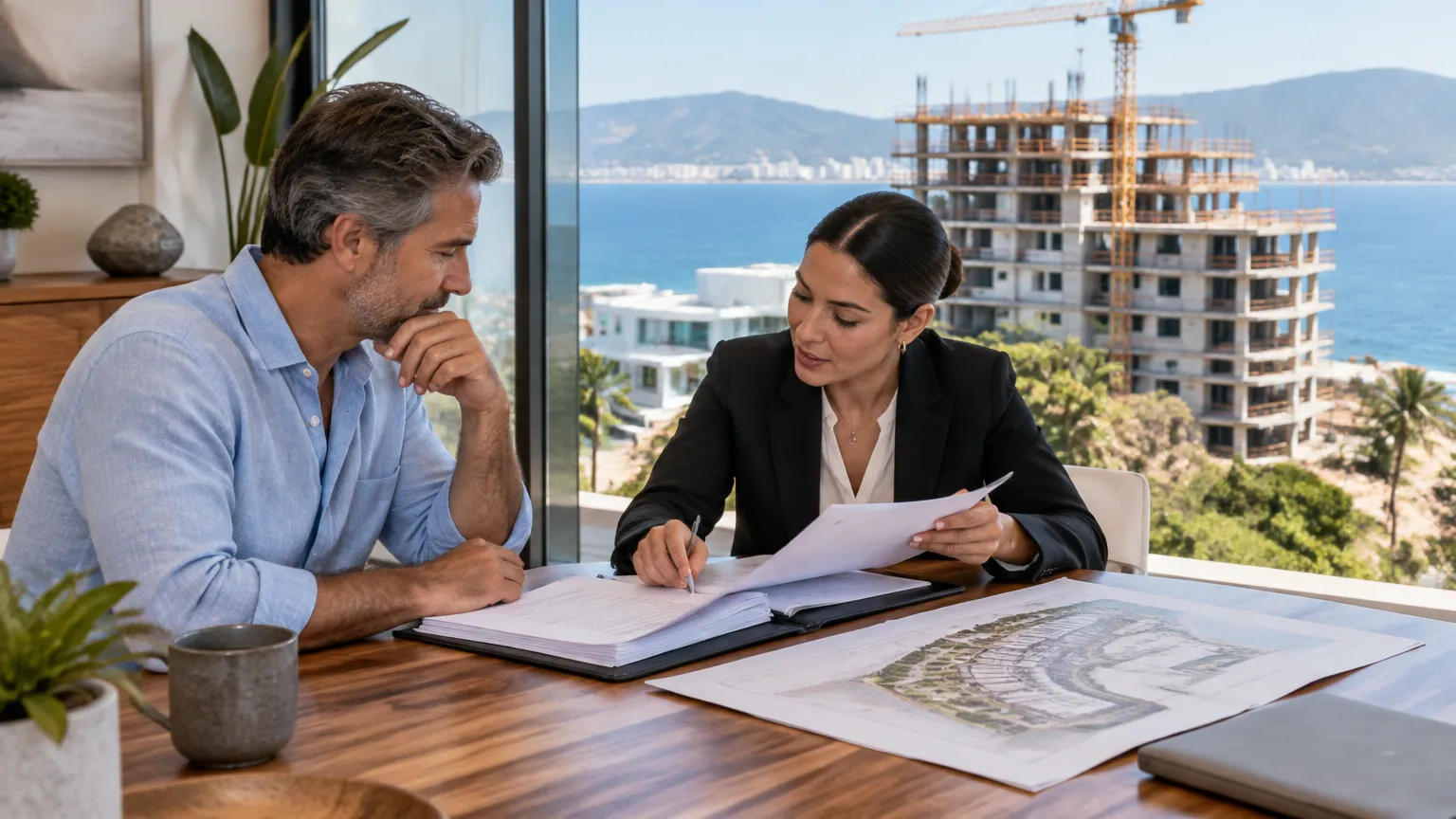
Off-plan sales in Bahía de Banderas look simple on the brochure: a folder of renderings, a payment schedule, and a sales agent who promises the building will be finished when you need the keys. The real risk sits behind the brochure. When you buy off-plan, you are paying for a building that does not exist yet, so the company selling it is the asset you must check first. Developer due diligence in Mexico means confirming that the company is real, that it controls the land, that it holds the right permits, and that your deposit cannot leave the transaction without legal protection. Here is how we run that check for foreign buyers.
Table of Contents
- Quick Takeaways
- Why Off-Plan Changes the Risk
- Confirm the Developer Is a Real, Active Company
- Check the Land Title Under the Project
- Liens, Trusts, and Where Your Money Goes
- Permits, Zoning, and the Condominium Regime
- Contract Terms That Protect an Off-Plan Deposit
- Comparing Three Verification Approaches
- Developer Track Record and Red Flags
- Frequently Asked Questions
- References
Quick Takeaways
| Key Insight | Explanation |
|---|---|
| Confirm the legal entity | Get the exact company name and tax ID, then match them to the seller on the reservation, the contract, and the account that receives your deposit. |
| Check the land, not the renderings | Pull the registry record for each lot and confirm the registered owner is the company selling to you, with a chain of transfers reviewed back at least ten years. |
| Treat ejido history as a stop sign | If the parcel was ever ejido land, request proof that the full ownership conversion is complete and registered before any money moves. |
| Verify the signer’s powers | A sales director’s title means little. Confirm the legal representative holds current, notarized powers that cover selling property and binding the company. |
| Keep deposits in a trust or escrow | Funds paid before title passes should move through a structure with an independent holder and release conditions, not into the developer’s operating account. |
| Get permits and the condominium regime in writing | Request the land use authorization, the construction license for your phase, and the condominium rules, then compare them with the contract. |
| Negotiate remedies before signing | Delivery dates, delay penalties, and refund terms must appear in the contract, because a promise made in a sales presentation is hard to enforce. |
Why Off-Plan Changes the Risk
With a resale home, the property already exists, you can walk through it, and the registry shows who holds title. Off-plan removes all three comforts at once. You are buying a promise that depends on a company, a land file, a permit set, and a construction schedule, and any one of them can fail while the others look fine.

The Brochure Is Not the Asset
The renderings, the showroom, and the sales agent are marketing. None of them tells you whether the company selling the units owns the land beneath them. Developer due diligence Mexico buyers can rely on starts by treating every brochure claim as something that needs proof.
Published Mexican guidance on legal due diligence for real estate makes the same point from the legal side. It treats due diligence as the step that determines whether title is enforceable and whether encumbrances can be cleared, not as paperwork you collect after you have already decided.
Where Off-Plan Deals Usually Go Wrong
The most expensive problems appear before construction starts. A buyer signs a reservation, wires a deposit to an account in the company’s name, and only then asks for the title record. At that point the developer holds the money and the buyer holds a contract with little behind it.
Reverse the order. Every document that controls your money should be reviewed before the first payment. That means the company file, the land record, the permit set, and the deposit structure, in that sequence.
Pro tip: Ask the developer to send the full document pack in one batch before you pay anything. A seller who delays the file for weeks while pushing a deadline is showing you how the rest of the transaction will go.
Confirm the Developer Is a Real, Active Company
Entity Name, Tax ID, and Registry Records
Start with the exact legal name. Many off-plan projects are marketed under a brand, a trade name, or a project name, and none of those is a legal person. Ask for the company’s full name, its tax identification number, and its incorporation documents, then match each one to the seller named in your reservation and to the account receiving your deposit.
Developers in Mexico usually operate as S.A. de C.V. or S. de R.L. de C.V. companies. Those forms are common, which is exactly why a name on a website proves nothing. Your lawyer should confirm the company exists, is active, and has a corporate purpose that covers building and selling property, using the public commerce registry records and the company’s bylaws.
Powers of the Person Signing for the Company
A project manager or sales director can sign many documents, but that does not mean they can sell land, instruct a trustee, or bind the company to a delivery date. Ask for the notarized powers of attorney held by the legal representative and check their scope, their date, and whether they remain in force. A contract signed by someone without those powers gives you a document the company can later disown.
In practice, we ask who the bylaws name as authorized to sell real property. If the answers from the developer conflict with the bylaws, the reservation is not ready for a deposit.
Check the Land Title Under the Project
Chain of Title and the Ten-Year Review
The land under a project is the first thing to verify, because a developer can own a company, a permit, and a sales office without owning the dirt. Obtain the registry record for each lot and confirm the registered owner matches the developer or the company signing the sale. Published guidance generally recommends reviewing at least the last ten years of transfers, and longer where the land has a complicated history.
Look for gaps. A transfer that never registered, a seller who does not appear in the chain, or a lot that was split without clear records should stop the file until your lawyer or a notary explains it in writing. Chain-of-title problems are cheap to find on paper and expensive to fix after construction begins.
Ejido History and Coastal Land Checks
Off-plan marketing often uses phrases like “private land” or “beachfront parcel” for lots that were once ejido land. Ejido land does not pass to a foreign buyer the way a private parcel does, and a developer may have a conversion in progress rather than a completed one. Ask whether the lot has ever been ejido land, and if it has, request proof that full ownership was granted and registered. Our ejido land guide walks through those checks step by step.
The same guidance notes that for coastal property or land with ejido history, the review must reach back to the origin of full ownership. A registry check that starts with the most recent sale misses the question that matters most.
Liens, Trusts, and Where Your Money Goes
Liens and Mortgages on the Lot
Before you pay, ask whether the land or the project is encumbered. A construction lien, a mortgage taken to fund the build, or a judgment against the company can all appear on the registry and turn your unit into a disputed asset. Request a current registry certificate yourself rather than accepting an older copy from the seller, and repeat the search shortly before closing.
A lot the developer cannot prove it owns is not a discount. It is a risk that has not been priced yet.
Lenders often hold the land as collateral during construction. That is normal, but it means your deposit may fund a project that a bank also has a claim on. You need written confirmation of how and when the lien will be released for your unit.
Fideicomiso Requirements for Off-Plan Buyers
Foreign buyers within about 50 km of a coast must hold property through a fideicomiso, a Mexican bank trust. Bahía de Banderas falls within that rule, so the trust is part of your due diligence, not an afterthought. The trust runs for 50 years and can be extended. Check which bank is trustee, who the beneficiary is, and whether the trust can receive your purchase before any deposit is paid. Our escrow article explains how these structures protect the money.
Off-plan buyers face a second question: where does the deposit sit before the trust is operational? Some developers ask for funds into a project account they alone control. We prefer a written deposit structure that releases money against defined milestones, with the trustee or an independent escrow arrangement holding the funds until conditions are met.
Permits, Zoning, and the Condominium Regime
Land Use and Construction Permits
A registered title tells you who owns the land. It does not tell you the building can legally be built as marketed. Ask for the land use authorization that matches the project type, the construction license covering the specific phase you are buying, and any environmental or zoning approvals the project requires. Get copies from the issuing office or through your lawyer, not from a sales PDF.
Compare the permit scope with the project description in your contract. A building approved for a certain number of floors or units cannot be sold as a different project. If the numbers do not match, you have found a problem before it costs you a deposit.
Condominium Rules Before You Sign
Most luxury units in the area sit inside a condominium regime, which means the rules that bind you come from a document many buyers never read. Check whether the condominium is formally established, whether the internal rules and the unit’s share of common areas are registered, and whether the developer still controls the owners’ association. Developer control can last well past delivery and affects who approves maintenance budgets.
Ask what the developer owes after delivery. Warranties, unfinished amenities, and utility connections often go unresolved for months. Put each obligation in writing before you sign, with a deadline for completion.
Contract Terms That Protect an Off-Plan Deposit
Delivery Dates and Remedies
The sales presentation may say the building will be ready in a particular season. The contract needs to say what happens if it is not. Look for a fixed delivery window, the developer’s obligation to compensate you for delays, a refund right if the deadline passes, and the exact process for returning your deposit. A clause that says delivery is “subject to construction progress” gives the developer control of the timeline.
Insist that the reservation and the purchase contract describe the same unit, the same price, and the same plans. Mismatches are common when the sales team uses one template and the legal file uses another, and the version the court or notary sees is the one that will count.
Pro tip: Attach the unit’s floor plan and finish schedule to the purchase contract. If the developer later substitutes materials or reduces the size of the unit, you will have a signed document to measure the change against.
Assignment and Resale Rights
Many off-plan buyers resell before delivery, so your exit matters as much as your entry. Check whether the developer must consent to an assignment of your rights, whether a fee applies, and whether the trust must be amended to name the new buyer. Each of these affects what you can do if your plans change before the building is finished.
Also read the withdrawal clause before the first payment. Some contracts forfeit a large share of what you have paid if you back out. If you will sign from abroad, our power of attorney guide explains how to limit what a representative can do on your behalf.
Comparing Three Verification Approaches
What Each Approach Actually Checks
Buyers usually choose between three ways to verify an off-plan developer. Each is better than nothing, but they give very different levels of protection. The table compares them on the questions that matter most before a deposit leaves your account.
| Approach | What It Checks | Where It Falls Short |
|---|---|---|
| Developer-supplied document pack | Corporate papers, permits, and brochures the seller chooses to share | The seller selects every page, and no independent party confirms registry status or deposit terms |
| Buyer-side registry and corporate search | Registry records for the land and the company, lien status, and the signer’s authority | Does not review permit scope, the condominium regime, or the deposit structure unless those are checked separately |
| Full legal due diligence file with trust and escrow review | Title chain, corporate authority, liens, permits, condominium rules, contract terms, and the path your money takes | Takes more time and needs a commitment to the review before you pay a deposit, but it is the only approach that covers the money path end to end |
Choosing the Right Level for Your Purchase
For a smaller unit from an established developer, a registry and corporate search may be proportionate, provided the deposit is held in a trust or escrow. For a high-value off-plan purchase, we recommend the full file, because the cost of missing one lien or one permit gap is far larger than the cost of the review. Our position is simple: the deposit should not move until the full file is in your lawyer’s hands.
A developer’s own file can be accurate and still incomplete. The difference is who has checked it. Use the registry as the source of truth, not the seller’s summary of the registry.
Developer Track Record and Red Flags
Completed Projects You Can Visit
A developer’s track record is evidence you can test. Ask for completed projects in Puerto Vallarta or Bahía de Banderas, visit them, and speak with owners if the developer allows it. Ask whether earlier projects were delivered on the dates promised and whether each unit’s title was registered in the buyer’s name. A vague answer to that second question is one of the most useful warning signs you will get.
Our luxury due diligence checklist covers the questions to ask on site, in the same order we use with clients.
Warning Signs in Payment Requests
Be wary of requests to pay a deposit into a personal account, a cash arrangement, or an account in a name that does not match the seller. Pressure to commit within days, or a discount that expires before your lawyer can review the file, is common in fraud and in weak developers alike. Verify any change to wire instructions by phone, using a number you already had, not one supplied in the same email. Our wire fraud red flags article lists the signals we check first.
How We Run Developer Checks for Clients
At Grupo Nar, every off-plan review starts with the company file and the registry, then moves to permits, the condominium regime, the contract, and the deposit path. Our bilingual team puts the findings in writing in English and Spanish, so you receive one clear report rather than a stack of documents to decode. Our office is at Mástil 14-3I, Marina Vallarta, Puerto Vallarta, Jalisco 48335.
The first consultation is free. Call +52 322 135 7031, message the same number on WhatsApp, or write to santonelli@gruponar.com before you sign a reservation. Having a lawyer review the file first costs far less than recovering a deposit later.

Frequently Asked Questions
Is it safe to pay a deposit on off-plan property in Bahía de Banderas before checking the developer?
No. The deposit is the moment your money is most exposed, so the company file, the land record, and the deposit structure should all be reviewed first. If the developer refuses to share these before payment, treat that refusal as the answer.
How far back should a title check go for a new development?
Published guidance generally recommends reviewing at least the last ten years of transfers. For coastal land or parcels with ejido history, the review should reach back to the origin of full ownership.
Do I need a fideicomiso to buy an off-plan condo near the coast?
Foreign buyers within about 50 km of a coast must hold property through a fideicomiso, a Mexican bank trust, and that covers Bahía de Banderas. The trust runs for 50 years and can be extended, so check the trustee, the beneficiary, and the trust’s readiness before any deposit.
Who should review the developer’s documents for me?
Your own lawyer should review them, because the notary formalizes the transaction for all parties involved. A lawyer working only for you can challenge the developer’s file, which the notary is not positioned to do on your behalf.
What is the single most useful document to request first?
A current registry certificate for the land, combined with the company’s corporate records. Together they show who owns the land and who has the authority to sell it, and they often reveal the first problem.
How much should I budget for closing costs on top of an off-plan price?
Closing costs in Mexico are often estimated at roughly 6 to 10 percent of the purchase price. On a $400,000 USD property, that range works out to about $24,000 to $40,000 USD, so plan for it when you calculate your total commitment.
If you have bought off-plan in Bahía de Banderas, we would like to hear what the developer’s paperwork looked like, so please share your experience with us at santonelli@gruponar.com.
References
- Methodological guide to legal due diligence for real estate investments in Mexico
- Overview of real estate due diligence in Mexico and the recommended ten-year transfer review