




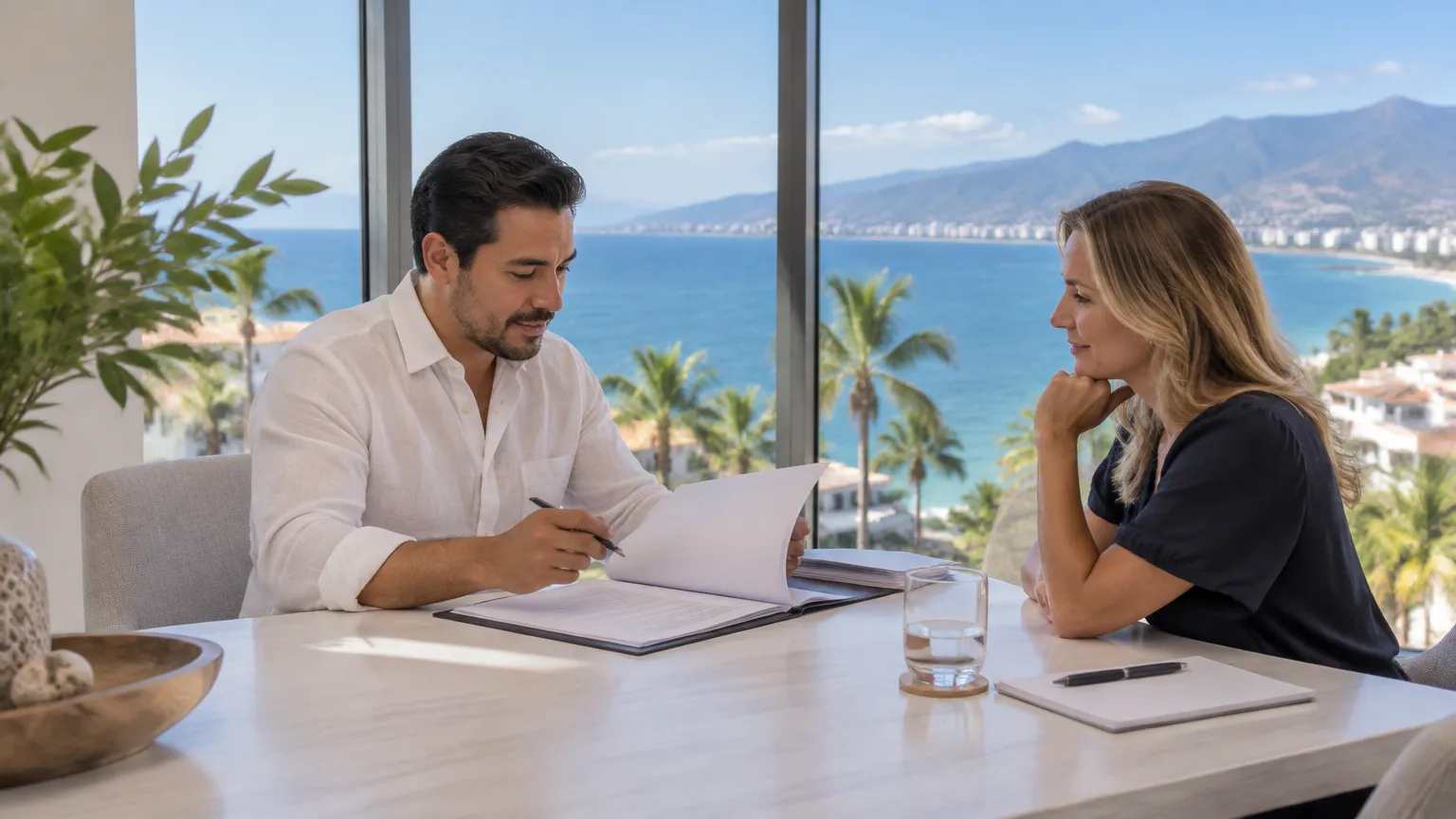
A free consultation with a real estate lawyer in Puerto Vallarta is one of the cheapest hours you will spend on a property purchase, but only if you use it well. Many foreign buyers walk in with a listing link and a vague sense of the process, then leave without knowing how the fideicomiso works, what closing will cost, or what a clean title search should show. This guide explains what to bring, which questions to put on the table, and where the answers usually reveal risk. It is written for buyers and sellers of luxury homes in Puerto Vallarta and Bahia de Banderas who want practical answers before they sign anything.
Table of Contents
- Quick Takeaways
- What a Free Consultation Covers
- What to Prepare Before You Call
- Questions to Ask Your Real Estate Lawyer in Mexico
- Closing Costs and Tax Questions to Raise Early
- Comparing Ways to Get Legal Input Before You Buy
- Common Mistakes Before Your First Meeting
- Frequently Asked Questions
- References
Quick Takeaways
| Key Insight | Explanation |
|---|---|
| Gather the seller’s paperwork first | Request the proposed purchase agreement, the seller’s proof of ownership, and recent property tax receipts so the lawyer can start a title search at the first meeting. |
| Expect closing costs to be a real line in your budget | The firm’s own guides give roughly 5 to 8 percent and roughly 6 to 10 percent of the purchase price. Ask for a line-item quote based on your exact price. |
| Confirm who holds the trust and how it renews | In a fideicomiso the bank is trustee and you are the beneficiary. Ask which bank, how the 50-year term renews, and how substitute beneficiaries are named. |
| Ask how escrow releases your money | Funds should move only when every condition in the contract is met. Ask who holds the account and see the release conditions in writing. |
| Insist on a bilingual review before signing | The Spanish text controls in Mexican property transactions, so an English summary alone is not enough protection. |
| Ask which value your transfer tax uses | Sellers and buyers should confirm whether the calculation starts from the purchase price or the cadastral value, because that changes the figure on your closing statement. |
What a Free Consultation Covers
The free initial consultation with our bilingual legal team is a scoping meeting, not a full legal review. Expect the lawyer to listen to your plan, explain the restricted-zone rules, and tell you which ownership path fits your goals. Because Puerto Vallarta sits in the restricted coastal zone, that explanation matters from the first minute.

In practice, you should leave with a list of documents to gather, a realistic cost picture, and a short list of risks to check. A useful consultation ends with clear next steps, not a sales pitch.
Restricted-zone rules in plain terms
Non-Mexicans hold residential property in the restricted zone through a fideicomiso, which is a renewable 50-year bank trust, or, for certain uses, through a Mexican corporation. The bank holds legal title as trustee while you keep the right to use, rent, remodel, sell, and pass the property on. Ask which structure suits your plans, because a trust and a company behave differently when you sell or when an heir inherits.
Who should attend and what the first hour covers
Bring the co-buyer, spouse, or whoever will hold the property if the decision is shared. Tax and succession questions get answered faster when the people who will live with the answer are in the room. The first hour should focus on scope and risk, with fees confirmed in writing afterward.
What to Prepare Before You Call
Preparation is what turns a free consultation into a useful one. A lawyer can only test a deal against the facts you bring, and most early risks show up in paperwork you already have or can request from the seller.
Documents to request from the seller
Ask for the proposed purchase agreement, any reservation agreement, the seller’s identification, and proof of ownership. If you can get the most recent property tax receipts, add them to the pile. If the home is part of a presale or a new development, also request the developer’s permits, because unregistered construction is one of the problems a title review is designed to catch.
List any existing trust, company, mortgage, or prior sale connected to the property. Earlier structures affect what happens at closing, and a lawyer who learns about them on day one saves you a second meeting.
Your budget and timeline
Write your budget in US dollars. Include the purchase price, a reserve for closing costs, and the trust setup fee. Note your target signing date and any deadline tied to the sale of your current home. A budget that stops at the purchase price is incomplete, because closing costs are usually paid by the buyer.
Your goals for the property
Are you buying a primary home, a rental, or a long-term holding for family? Will you rent it short term? Will heirs inherit it? Each answer changes whether a trust, a company, or a combination makes the most sense. Our buying guide explains how the trust handles use, rent, and inheritance, but your facts decide how those rules apply.
Pro tip: Write your questions in English and Spanish before the call. Bilingual notes help your lawyer answer quickly, and they show you where the Spanish wording will matter later.
Questions to Ask Your Real Estate Lawyer in Mexico
Good questions test how a lawyer thinks, not just what they know. Ask each question below and listen for specifics. A vague answer about title or fees is a warning sign, even when the lawyer sounds confident.
Questions about the trust
Ask which bank would hold the fideicomiso, what the setup fee and annual trust fee look like, and how beneficiary designations work. Ask whether the trust renews and how substitute beneficiaries are named. The right answer should explain how the property passes to heirs without Mexican probate, and it should be documented, not just described.
Questions about title and the seller
Ask who will run the title search and whether it covers the full chain of ownership. Ask which liens, unpaid property taxes, and ejido-land issues will be checked. A thorough lawyer will also confirm that the seller has the legal capacity to sell.
Then ask the question that separates a good answer from a sales answer: what would make you tell me not to sign? A strong lawyer names specific deal breakers, such as unregistered construction or a presale without visible permits.
Questions about the contract and escrow
Ask whether the purchase agreement will be drafted or reviewed in both English and Spanish, and which clauses the lawyer expects to push back on. Ask how escrow is structured so funds are released only when every condition is met. Ask who holds the money and request the release conditions in writing.
Pro tip: Ask the lawyer to name the one document they want to see before you put money down. Their answer shows what they consider the biggest risk in your specific deal.
Closing Costs and Tax Questions to Raise Early
Cost questions are where many free consultations go wrong. Buyers ask for a percentage, hear a range, and leave without a number they can plan around. Our firm’s guides put buyer closing costs at roughly 5 to 8 percent of the purchase price in one place and roughly 6 to 10 percent in another, so ask for an estimate based on your exact price.

Our estimate calculator assumes MX$18.50 per US dollar, so ask which exchange rate any peso-denominated quote uses. A small difference in rate can shift the total noticeably on a luxury purchase.
The line items to demand
Ask for a breakdown covering the property acquisition tax, Notary Public fees, the trust setup and first-year bank fee, and permits and registration. A quote that bundles everything into one figure hides the parts you can verify or negotiate. Our closing cost guide for Puerto Vallarta walks through these items in more detail.
Also ask what the Notary Public does and does not do. The notary is a neutral public official who formalizes the deed. A notary does not represent you, so you still need your own lawyer.
Transfer tax and seller-side questions
Sellers who want to estimate their capital gains tax should bring their original purchase records, documented improvements, and the price they paid. Ask which value your transfer tax is calculated on, the purchase price or the cadastral value, because the answer changes the number on your closing statement. Ask also which income tax filings the seller must complete. Our tax team handles property owners and foreign residents, so these questions belong in the first meeting, not after signing.
Pro tip: Bring any cadastral value notice you already have. It lets the lawyer test whether a transfer tax estimate is built on the right figure before you rely on it.
Comparing Ways to Get Legal Input Before You Buy
Buyers usually choose among a few ways to get advice before closing. Each has a place, but only a retained lawyer stays accountable for the file from the first call through the signing table.
| Approach | What You Get | Best For |
|---|---|---|
| Free initial consultation | A scoping call, a list of documents to gather, and a short list of risks to check | Buyers deciding whether they need full legal counsel |
| Full retained representation | Title search, contract review, trust setup, escrow coordination, and closing with the Notary Public | Buyers who want one bilingual team across the whole transaction |
| Agent or notary-only guidance | Timing help and paperwork support, but no lawyer working only for your interests | Buyers who already have independent counsel in place |
For most foreign buyers, the free consultation is the right first step. Do not treat the notary or the seller’s agent as your advisor, because neither works only for you. If you are weighing a bilingual lawyer against other options, our article on why foreign buyers need one explains what that role covers.
Common Mistakes Before Your First Meeting
Most wasted consultations follow the same pattern. Buyers arrive after the offer is signed and the closing date is set, which leaves the lawyer with little room to change the terms.

Arriving late is only one problem. Buyers who bring a partial file, a verbal price, or a deadline they have not confirmed in writing make it harder for any lawyer to protect them.
Using a lawyer recommended by the seller
A common mistake is accepting the seller’s or the agent’s lawyer as your own. That lawyer’s duty runs to whoever hired them. You need someone who works only for you, and who can tell you when the seller’s version of events does not match the registry.
Signing a Spanish contract you have only skimmed
The Spanish text controls in Mexican property law, so a translation or an English summary is not enough. Ask for a clause-by-clause bilingual review before you sign a reservation agreement or a purchase agreement. The few hours it takes are cheaper than unwinding a misread obligation later.
Treating the consultation as a sales call
A free consultation should produce facts, not a commitment. If a firm pushes you to sign on the first call or will not put its fee structure in writing, walk away. A good lawyer is comfortable with you taking time to compare options.
The cheapest legal mistake is the one you catch before you sign. A one-hour conversation costs nothing, while a title problem found after closing can cost you the property.
Pro tip: Put every deadline in writing before the call, including reservation expiry dates and any seller deadline. A lawyer can only protect a timeline they know about, and a missed reservation date can change your negotiating position overnight.
Frequently Asked Questions
Is the initial consultation with a real estate lawyer in Puerto Vallarta really free?
Yes. Grupo Nar offers a free initial consultation with its bilingual legal team. To schedule, call +52 322 135 7031 or email santonelli@gruponar.com, and you can also reach the team on WhatsApp at the same number.
Can a foreigner buy property in Puerto Vallarta?
Yes. Because Puerto Vallarta sits in the restricted coastal zone, non-Mexicans usually hold residential property through a fideicomiso, a renewable 50-year bank trust. For certain uses, a Mexican corporation may be the right structure instead.
Do I still need my own lawyer if a Notary Public is handling the closing?
Yes. The Notary Public is a neutral public official who formalizes the deed, and does not represent the buyer or the seller. Your own lawyer checks title, reviews the contract, and protects your interests before you reach the signing table.
How much should I budget for closing costs?
Our guides estimate buyer closing costs at roughly 5 to 8 percent of the purchase price in one article and roughly 6 to 10 percent in another. Ask for a line-item quote based on your exact price before you commit to a budget.
What should I bring to a free consultation?
Bring the proposed purchase agreement, any reservation agreement, the seller’s proof of ownership, recent property tax receipts, your budget, your timeline, and a list of questions in English and Spanish. The more history you bring, the faster a title review can start.
Is a free consultation useful for sellers too?
Yes. Sellers can use the first meeting to estimate their capital gains tax and to confirm which value the transfer tax is calculated on. Bring your original purchase records and any documented improvements so the numbers start from accurate facts.
Have you had a free consultation with a lawyer before a property purchase in Mexico, and which question would you add to this list?